How to Avoid Underbidding Structured Cabling Jobs
Key takeaways
- Price labor at its burdened cost — 30 to 60 percent above base wage, divided by actual productive hours
- Walk every site before you bid and price firestopping, pathway, and lift time as separate line items
- Know the market range ($150–$250 per drop for commercial Cat6) and treat anything below your floor as a job worth losing
Most contractors who lose money on cabling work don't lose it on the job site. They lose it three weeks earlier, at the desk, when they wrote a number that was wrong before the first reel came off the truck. Underbidding isn't really a pricing problem; it's an information problem. You either didn't know what the job would actually cost you, or you knew and talked yourself out of it because you wanted the work.
Both are fixable. But you have to fix them in order, because a great markup on a bad cost estimate is still a losing bid.
Start With What Your Labor Actually Costs
Here's the single biggest reason cabling contractors underbid: they estimate labor at the base wage. If you're paying a tech $28 an hour and your estimate carries labor at $28 an hour, you're losing money on every hour before you've bought a single jack. Once you add payroll taxes, workers' comp, liability insurance, health benefits, PTO, training, and the tools and truck that tech uses, the real cost of that hour runs 30 to 60 percent above the wage. Your $28 tech costs you $38 to $45 an hour just to exist on your payroll.
Then there's the divisor problem. A full-time employee gets paid for 2,080 hours a year, but nobody bills 2,080. Strip out holidays, vacation, sick days, training, shop time, and the drive between jobs, and you're lucky to get 1,600 to 1,750 productive hours. Divide your annual labor cost by paid hours instead of productive hours and you've understated your true hourly cost by another 10 to 25 percent, stacked right on top of the burden you already missed.
The compounding is what kills you. Say you bid a 200-drop job at 1.5 hours per drop, a reasonable production rate for pull, terminate, test, and label on a mid-size commercial project. That's 300 labor hours. Priced at $28, your labor line is $8,400. Priced at a true burdened-and-productive cost of $44, it's $13,200. You just underbid the labor by $4,800 on one line item, and labor is typically 60 to 70 percent of a structured cabling job's total cost. There's no material markup on earth that claws that back.
One estimating consultant put a number on a related version of this mistake: a contractor who assumed a 20 percent overall labor burden when the actual workers' comp rate alone pushed it to 35 percent underbid a $50,000 labor component by $7,500. That's not a rounding error. That's the profit on the job, gone before mobilization.
So do the math once, properly. Total annual cost per tech (wage, taxes, comp, benefits, truck, tools, phone) divided by realistic productive hours. That's your floor. Every estimate gets built on that number, not the wage.
Bid the Whole Job, Not the Drawings
The second way contractors underbid is scope. Most cabling bids cover cable and connectivity and quietly assume everything else is someone else's problem. Then the job starts and you discover that pathway, firestopping, grounding, sleeves through rated walls, patch-and-paint coordination, and lift rental were, in fact, your problem; they just weren't in your number.
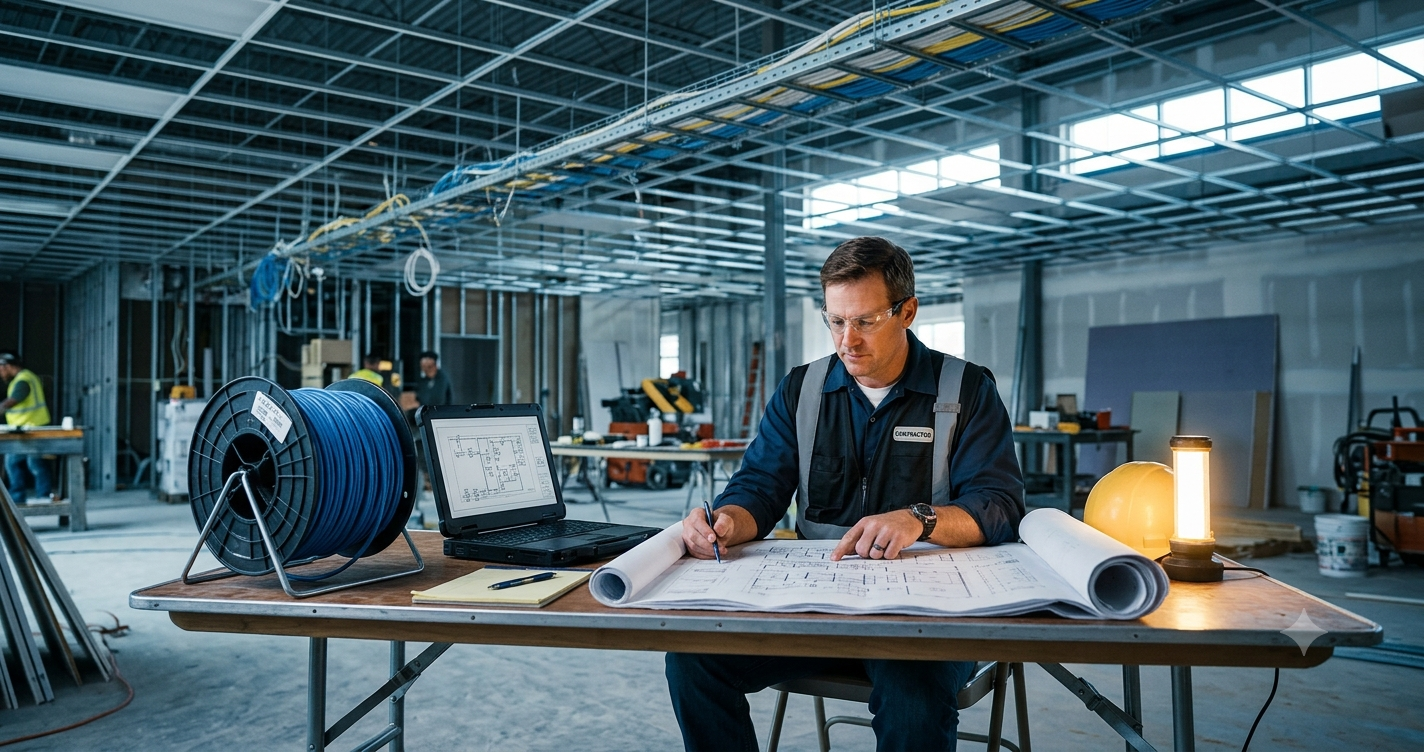
The fix is boring and it works: walk the site before you bid, every time, and price the stuff drawings don't show. Drawings show you drop counts and telecom room locations. They don't show you the hard-lid ceiling in the corridor, the plenum stuffed with twenty years of abandoned cable, the freight elevator you can only book from 6 to 8 a.m., or the fact that half your runs cross a two-hour rated wall. Older buildings with congested ceilings can take up to three times the normal labor per drop to route properly. If you bid that building off a floor plan at your clean-building production rate, you didn't win a job; you bought one.
While you're walking it, count the line items most bids miss. Firestopping is the classic: every rated penetration means drilling, sleeving, and coming back with firestop compound, and contractors routinely treat it as a rounding error and then burn a full day on it. Price penetrations as their own line. Same for lift time above twelve feet, after-hours access procedures, and testing scope, full Fluke certification with documentation runs a few minutes per drop, which on 200 drops is a couple of days of technician time, plus you're amortizing a tester that cost $5,000 to $10,000.
And ask questions before you submit. General contractors and IT managers will tell you the bidders they trust least are the ones who priced a drawing set without a single RFI. Plenum or riser cable? Plenum-rated jacket costs 20 to 30 percent more, and on a Cat6A plenum job, materials alone can run $40 to $60 more per drop than riser-rated Cat6. Who provides the racks? Who patches the drywall? Is there a spec for labeling and test reports? Every one of those answers moves your number, and every one you guess at is a change-order fight or an eaten cost later.
Here's the mistake-to-avoid, and it comes straight from watching a real bid go sideways: a contractor priced a 60-drop office retrofit off the floor plan at his usual rate, skipped the walk because the building was forty minutes away, and found hard-lid ceilings over every corridor on day one. Every pathway needed access holes cut, and the patch-and-paint wasn't in anyone's scope. The job ran 80 percent over on labor and he ate all of it, because you can't change-order a condition that was sitting in plain sight before you bid. The forty-minute drive would've been the most profitable hour on that project.
Know the Market, Then Hold Your Number
Once your costs are honest, you need context, because underbidding isn't always a math error. Sometimes it's a nerve error. You know the job costs $180 a drop to do right, a competitor's at $130, and you shave your number to chase them.
Know where the market actually sits. In 2026, straightforward commercial Cat6 work generally lands between $150 and $250 per drop, all-in with materials, termination, and testing. Cat6A, plenum-heavy, after-hours, or certification-heavy work runs $200 to $350 and up. Isolated drops in finished walls can hit $200 to $400 each. And project size moves the number hard: a 10-drop job might legitimately price at $400 a drop because mobilization and minimum-day labor spread over almost nothing, while a 500-drop job in the same building might pencil at $175. If a competitor's number only works at big-job economics on a small job, that's not a price you need to match. That's a contractor who's about to have a bad quarter.
There's also a version of low bidding that's a strategy, not a mistake, the $125-per-drop proposal that's really a $250-per-drop job once the change orders start. Smart clients have learned to fear it, which means your $175 all-inclusive number with a clear scope letter is genuinely competitive against it. Spell out what's included, line by line, and what triggers a change order. You're not just protecting yourself; you're giving the buyer a reason to pick the honest number.
Build in margin for the stuff that always happens. Overestimate your cable, runs measure longer than they scale, and a box of slack costs a lot less than a Friday-afternoon supply run. Add a contingency line, because something always bites you on cost or schedule. Industry research pegs estimating errors at up to 20 percent of total project costs across construction; the contractors who survive aren't the ones who never miss, they're the ones whose margins absorb the miss.
And decide, in advance, that some jobs are worth losing. Winning work below your burdened cost isn't revenue; it's paying for the privilege of being busy. The bid you lose at your real number costs you nothing. The one you win at somebody else's number can cost you the year.
Keep reading

Quote faster with NexVolt
Professional, branded estimates for low-voltage work, in minutes.
Start your free trial