How to Bid Conference Room AV Installations Profitably
Key takeaways
- Price rooms by tier — huddle rooms run $2,500-$4,500 installed while standard rooms land at $15,000-$35,000
- Keep blended project margin above 30% and bill AV labor at $85-$150 per hour, not cabling rates
- Estimate programming and commissioning as their own line items — they're the hours that quietly eat your profit
Most low-voltage contractors lose money on conference room AV the same way: they bid it like a cabling job with a TV on the end. Pull the wire, hang the display, mount the camera, done. Then the client's IT guy asks why the Teams Room console won't pair, the ceiling mic picks up the HVAC better than the CEO, and you're eating two unbilled days of troubleshooting on a room you priced at eight hours.
Conference room AV can be seriously profitable — labor margins across the integration industry average around 55%, better than most structured cabling work. But you only capture that margin if you bid the job for what it actually is: a systems integration project with a network dependency, a software layer, and a client who'll judge the whole thing by whether the first meeting goes smoothly.
Here's how to price it so the number on your proposal survives contact with the job site.
Know the market rates before you open your estimating sheet
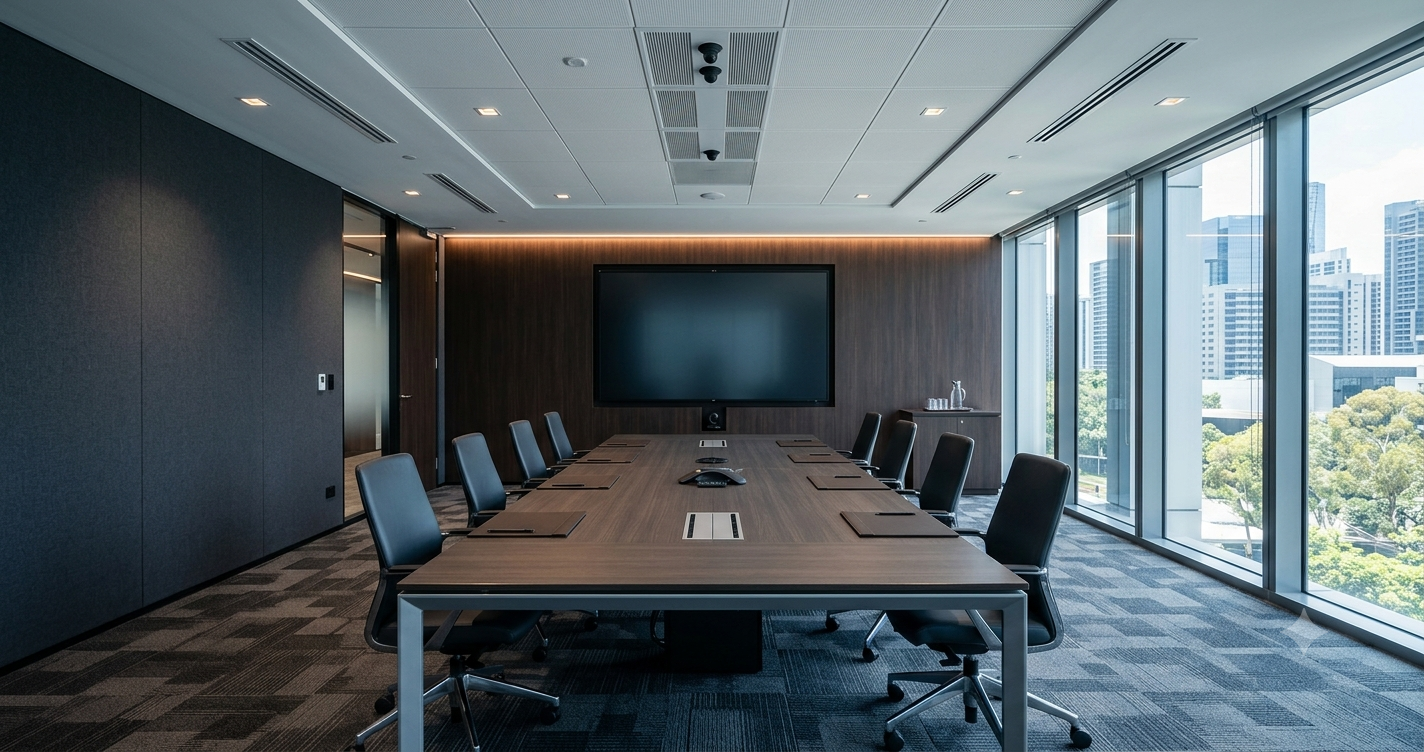
You need anchor numbers, because your client has already Googled them. A complete standard conference room — display, camera, audio, room compute, control, installed and configured — typically lands between $15,000 and $35,000 in the current market. Small huddle rooms built around an all-in-one video bar run $2,500 to $4,500 installed. Large boardrooms with modular components, ceiling mic arrays, and DSP-tuned audio run $12,000 to $28,000, and the premium 21:9 "Front Row" style rooms push past $50,000. Big-name integrators are quoting inside these bands, so if your bid comes in at $6,000 for a 16-person boardroom, the client won't think you're a bargain. They'll think you missed something. They'll be right.
On the labor side, AV installation and commissioning rates run $85 to $150 an hour nationally, and techs in major metros with networking certs command $100 to $200. If you're billing AV work at your cable-pulling rate, you're leaving the most profitable part of the job on the table. The client isn't paying for someone who can lift a display onto a mount — they're paying for someone who can make a Crestron panel, a Shure mic array, a Logitech camera, and their corporate network all behave like one product.
For equipment markup, the industry pattern is tiered. Commodity gear — mounts, cables, connectors, patch panels — takes 40 to 60% markup, and nobody blinks because the dollar amounts are small. Mid-range hardware like displays, video bars, and cameras carries 25 to 35% in commercial work. High-end items — that $8,000 beamforming ceiling mic, the DSP, the large-format display — get 20 to 30%, because the sticker price is big enough that clients will price-check it online. Run those tiers and a healthy labor rate and your blended project margin should sit above 30%. If a bid pencils out below 30% blended, don't sharpen your pencil — figure out which number is wrong. Usually it's labor hours, and usually you're low.
Build the estimate in layers, not a lump
The bids that go sideways are almost always the ones estimated as one blob: "conference room AV install — 24 hours." The bids that hold up break the work into phases you can sanity-check individually.
I estimate every room in four buckets: physical installation, integration and configuration, commissioning and tuning, and training with documentation. Physical install is the part you already know how to estimate — mounting, rough-in, cable paths, rack work. It's also the part contractors estimate most accurately, which creates false confidence about the rest.
Integration and configuration is where the room becomes a system. Enrolling the room compute in the client's tenant, VLAN and firewall coordination with their IT team, firmware updates on every device (budget for this — half the gear ships with firmware that needs updating before the platform will certify it), pairing controllers, loading control programs. For a standard mid-size room, I won't put fewer than 8 to 12 hours here, and that assumes the client's IT department answers emails.
Commissioning and tuning is the layer most low-voltage guys skip in the estimate entirely, because in cabling work "commissioning" means test and certify the link. In AV it means sitting in the room making test calls, adjusting mic pickup lobes so the far end doesn't hear the air handler, setting camera presets, tuning speaker levels so the back row can hear without the front row wincing, and verifying the one-touch-join experience actually takes one touch. Four to eight hours for a standard room, more if there's DSP work. It's also worth budgeting a return visit — something like 15% of rooms need a tweak in the first two weeks once real meetings expose what test calls didn't.
Then price the recurring layer, because that's where the good AV businesses are actually built. Microsoft charges around $40 per room per month just for the Teams Rooms Pro license — put it on your proposal so you're the one billing it. Beyond licensing, room-monitoring and support agreements in the market run anywhere from $200 to $1,000 per room per month depending on response time and whether hardware refresh is included. Even a modest support agreement at $150 a month per room turns a five-room office into $9,000 a year of recurring revenue you didn't have to re-win.
The mistake that eats integrators alive: unscoped programming hours
Here's the one that costs real money, and nearly every contractor who's crossed from cabling into AV has paid this tuition. A contractor bids three conference rooms for a law firm. Hardware's priced right, mounting hours are right, cabling's right. The proposal says "system programming and setup" as a single line with 6 hours across all three rooms, because how hard can setup be — the video bar is supposedly plug-and-play.
Then reality: the client's IT is outsourced and takes four days to open firewall ports. The touch controller ships with firmware that won't pair until it's updated, which requires internet access the room doesn't have yet. The client decides mid-install that the boardroom also needs wireless presentation for guests, which means BYOD switching that was never in scope. The contractor burns 30-plus hours across the three rooms on "setup" and the entire labor margin is gone — on a job where every physical task came in on budget. Industry cost-variance data backs this up: labor overruns are the biggest source of blown AV budgets, and it's almost never the mounting hours that overrun. It's programming, configuration, and commissioning.
Two protections. First, make programming and commissioning visible, separate line items with real hours attached — clients accept the number far more readily when it's on the proposal than when it's a change order. Second, put IT dependencies in writing in your scope: client provides network drops, VLAN configuration, firewall rules, and tenant credentials by a named date, and delays on their side bill at your hourly rate. That single paragraph has saved me more margin than any supplier discount ever has.
One more scope note: walk the room before you price it. That $15,000-to-$35,000 range is wide partly because of what's around the AV — if the room needs electrical work behind the display, structural blocking for a 98-inch panel, network switch upgrades (commonly $2,000 to $5,000 when the client's closet can't handle PoE budgets), or millwork to hide the rack, those are real dollars that don't show up on a floor plan.
Fixed-price the defined scope, and price it with the layers above so the fix in "fixed" protects you instead of the client's facilities manager. Conference rooms are repeatable — once you've built an accurate template for a huddle room, a standard room, and a boardroom, every future bid is a config exercise instead of a guess. The contractors making real money in this niche aren't the ones winning on price. They're the ones whose third room costs them 20% fewer hours than their first, while the invoice stays the same.
Keep reading

Quote faster with NexVolt
Professional, branded estimates for low-voltage work, in minutes.
Start your free trial