How to Price a Structured Cabling Job for a New Office
Key takeaways
- Price new-construction Cat6 drops around $150-$250 and scale down as drop count climbs
- Budget the MDF/IDF buildout, fiber backbone, and certification as separate line items, not per-drop padding
- Bid at least two mobilizations and protect yourself against GC schedule slip in writing
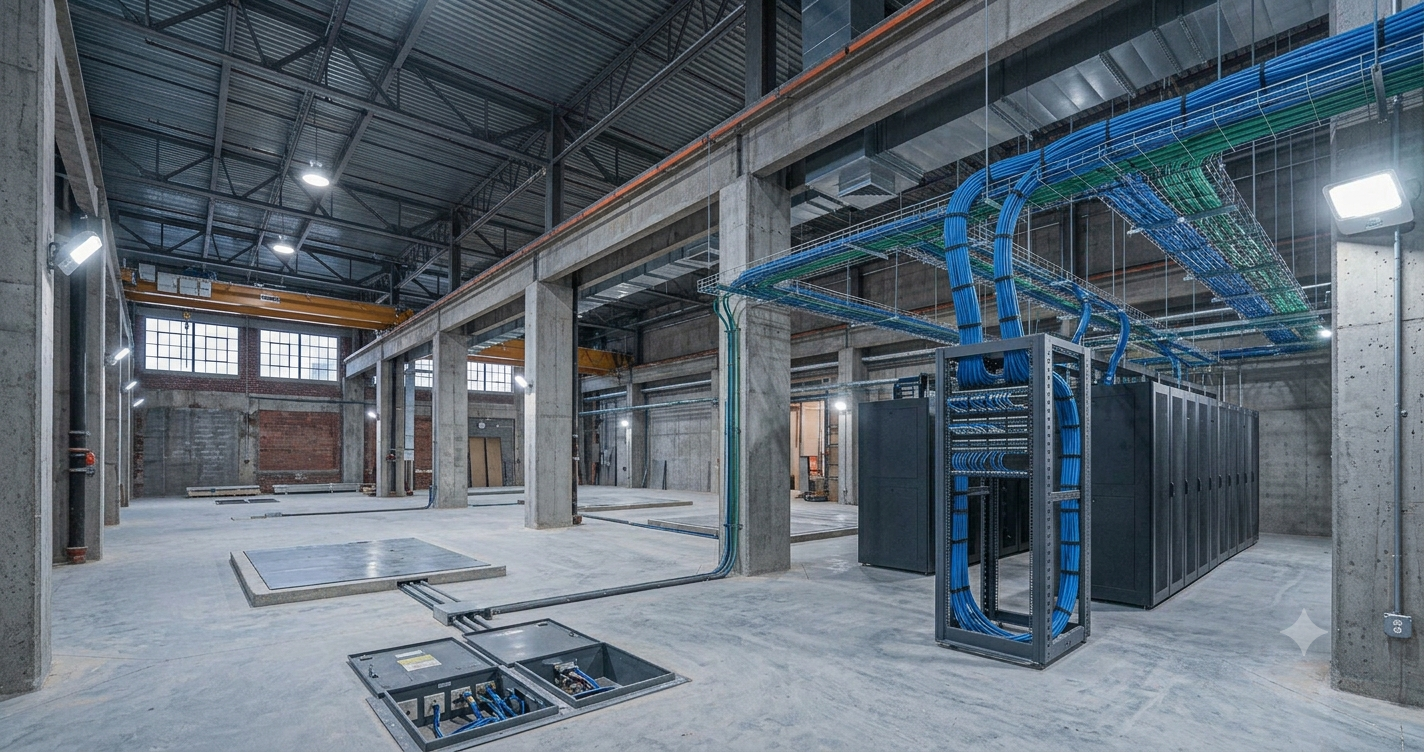
New construction is the best cabling work there is. The ceilings are open, the walls are studs, nobody's working over a dentist's chair at 2 a.m., and your per-drop cost runs 20 to 40 percent below the same job as a retrofit. It's also the easiest work to lose money on, because you're pricing off a set of drawings for a building that doesn't exist yet, on a schedule you don't control, for a general contractor who will absolutely call you back a third time when the drywallers bury your boxes.
So let's walk through how to build the number properly.
Start with the takeoff, not the per-drop rate
Everybody wants to jump straight to "what do I charge per drop," and we'll get there, but the per-drop rate is the last thing you calculate, not the first. The first thing is an honest takeoff from the prints.
Pull the floor plans and the furniture plan if you can get it, and count every location: workstations (usually two drops each — figure a data and a spare, since voice is mostly gone to softphones now), conference rooms, printers and copiers, wireless access points, cameras, door access points, TVs and digital signage, the reception desk everyone forgets. On a typical 15,000 square foot office buildout you'll land somewhere between 80 and 150 drops once you count everything honestly. Then read Division 27 of the spec book, because "per plans and specs" is a contract term, and if the spec calls for Cat6a to the WAPs, a manufacturer-certified installation with a 25-year warranty, or a specific labeling standard, that's your scope whether you noticed it or not.
Next, figure your average run length. Don't guess. Scale three or four of the longest runs and three or four of the shortest off the prints, average them, and add 15 to 20 feet per run for service loops, riser paths, and the vertical drops at both ends. Most offices average out somewhere between 120 and 180 feet per run. That number matters because it drives your cable count — at a 150-foot average, a 1,000-foot box of plenum Cat6 gets you about six drops, and with plenum-rated boxes running roughly $200 to $300 each depending on brand and the copper market that week, cable alone is $30 to $50 per drop. Add a jack, faceplate, patch panel port share, patch cords, J-hooks or tray share, and Velcro, and your all-in material cost per drop typically lands between $40 and $70 for Cat6. Cat6a pushes that up 25 to 40 percent — thicker cable, pricier connectors, fewer drops per box.
Now labor. Across rough-in, trim-out, termination, and testing, a competent two-person crew in open new construction should average 1.5 to 2 hours of total labor per drop across the whole job — better than that on long open pulls, worse on the scattered singles. Here's where a lot of guys hurt themselves: they price labor at what they pay the tech. The average low-voltage tech in the U.S. is making around $27 to $31 an hour right now, but by the time you add payroll taxes, workers' comp, liability insurance, the van, the fuel, the tester, PTO, and the hours you can't bill, your loaded cost is realistically $45 to $55 an hour. Price off the wage instead of the loaded cost and you've donated ten bucks an hour before you've marked up anything.
Put it together and the math checks against the market. Standard commercial Cat6 in new construction is going for roughly $150 to $250 per drop in most U.S. markets in 2026, with Cat6a running about $200 to $325. And the scale curve is real: a 10-drop tenant suite might justify $350 to $400 a drop because mobilization and minimum-day labor get spread across almost nothing, while a 400-drop core-and-shell job might pencil at $160 because your crews stay productive for weeks without moving the truck. If your bottom-up number and your per-drop-times-count number disagree by more than about ten percent, stop and find out why before you submit anything.
The money outside the drops
The drops are the visible part of the bid. The invisible part is where new-construction jobs quietly bleed.
Every telecom room is its own line item. A basic IDF — two-post rack, patch panels, horizontal management, ladder rack, grounding busbar and bonding — runs $1,500 to $4,000 in materials and labor before a single horizontal cable lands in it, and a proper MDF with a four-post rack and more real estate can go well past that. A three-story building means an MDF plus at least two IDFs, so you're carrying $6,000 to $12,000 of room buildout that has nothing to do with your per-drop rate.
Then there's backbone. Almost every multi-floor office is hybrid now: fiber risers between rooms, copper horizontal to the devices. Fiber runs two to three times the cost of a copper drop once you account for the cable, the fusion splicing or termination, the enclosures, and the OTDR testing. A pair of 12-strand OM4 risers between three rooms can easily be a $4,000 to $8,000 chunk of scope. Firestopping every penetration is on you too, and inspectors in most jurisdictions actually look now.
Finally, the closeout package. Full certification testing to TIA-568 on every drop, printed or PDF test results, labeling at both ends per the spec, and as-built drawings. Figure five to ten minutes per drop for testing and labeling alone, plus real office hours for the documentation. The lowball bidders skip this, and it's exactly why their number is $40 a drop under yours. When the GC waves a cheaper bid at you, ask whether it includes certification reports and as-builts. Half the time it doesn't, and now you've got something to talk about.
Bid the schedule, not just the drawings
Here's the mistake that costs contractors the most on new construction, and I've watched it play out more than once: pricing the job as one continuous visit.
A colleague of mine bid a 120-drop office buildout a couple years back at a sharp per-drop rate that assumed his crew would roll in, rough-in, trim, test, and leave. What actually happened is what always happens. Framing ran late, so rough-in got pushed twice. He got his cable in, then drywall buried a dozen mud rings and someone screwed through two home runs, which meant re-pulls. Ceiling grid went in three weeks late, so trim-out became two separate trips scheduled around the painters. By closeout he'd mobilized five times on a job he'd priced for two, and every one of those extra trips was a morning of load-up, drive, setup, and teardown that produced maybe four billable hours. His material number was fine. His labor number was fiction. The job finished at roughly break-even, and that's before he spent two unpaid afternoons chasing the GC about the damaged runs.
So build the bid around how new construction actually flows. Price a minimum of two full mobilizations — rough-in before insulation and drywall, trim and test after paint and grid — and add a contingency trip or two on anything over 100 drops. Put language in your proposal that repair or replacement of cable damaged by other trades is billable T&M, and photograph your rough-in before you leave, because that photo set is the difference between a paid change order and an argument. Spell out that schedule delays beyond a stated window carry a remobilization charge. And read the payment terms: commercial GCs commonly hold 5 to 10 percent retainage until final completion, and pay-when-paid clauses are standard, so your pricing has to survive floating payroll and materials for 60 to 90 days. If your margin can't absorb that float, the margin's too thin.
None of this is exotic. Count honestly off the prints, price labor at loaded cost, carry the rooms and the backbone and the closeout as their own numbers, and bid the schedule you're actually going to live through instead of the one on the bar chart. Do that consistently and you'll lose a few jobs to the guy bidding $120 a drop with no test results — and you'll still be in business when the GC calls you to come fix his work.
Keep reading



Quote faster with NexVolt
Professional, branded estimates for low-voltage work, in minutes.
Start your free trial