How to Write a Winning Bid for an AV Integration Project
Key takeaways
- Target a 35–45% blended gross margin, not a race to the lowest price
- Break out programming and commissioning as separate line items at $90–$130/hr
- List what's excluded from scope as clearly as what's included
The first thing to get straight: the winning bid on an AV integration job is almost never the cheapest one. I've lost bids by $8,000 to competitors who went on to blow the schedule, botch the DSP programming, and hand my old prospect a boardroom where the far-end audio sounded like a drive-thru speaker. Six months later that client called me to fix it, and they've been mine ever since. Commercial clients buying integrated AV are buying an outcome — a room that works when the CEO walks in at 7:58 for an 8:00 call. Your bid wins when it convinces them you're the one who can deliver that outcome, and it stays profitable when your numbers underneath are honest.
So let's talk about how to build a bid that does both.
Scope the room before you price the gear
Most losing bids die at the discovery stage, before a single number gets written. If you're pricing off a two-paragraph RFP email without a site walk, you're guessing, and your competitor who spent ninety minutes on site asking questions is going to out-position you.
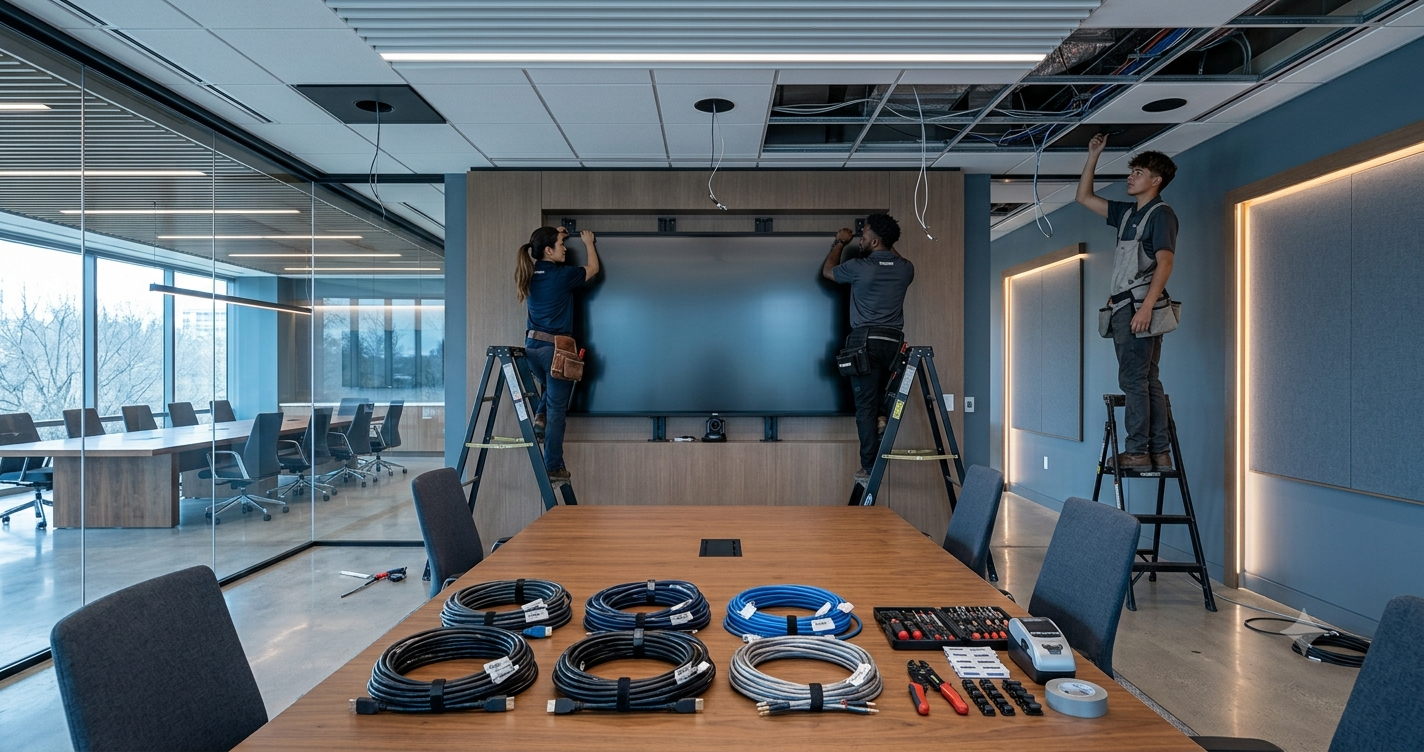
On that walk, you're looking past the equipment list. Is this new construction with open ceilings, or a finished space where every cable run means lift work above a drop grid and patching drywall? That distinction alone swings your labor number hard — installation labor typically runs 20–25% of project cost on new construction with pre-wire access, but 35–40% on a retrofit in a finished space. A $40,000 boardroom in an occupied law office is a very different animal than the same gear package in a shell space, and your bid needs to reflect that or you'll eat the difference.
Ask what the room actually has to do. "We need video conferencing" can mean a $5,000 huddle room with a soundbar and a Teams panel, or a $50,000 divisible boardroom with ceiling mics, camera tracking, and room combining logic. Typical corporate meeting rooms these days land somewhere between $18,000 and $50,000 installed, and per-square-foot pricing runs from around $60 for a simple huddle space to over $200 for a full auditorium. If the client's expectations and their budget live in different zip codes, you want to find that out now, in conversation, not after you've burned twelve hours building a proposal they'll faint at.
One more discovery question that pays for itself: who owns the network? Modern conferencing gear lives on the client's LAN, and AV-over-IP designs can add 15–30% to a project's cost while dragging their IT department into your critical path. Get the IT contact's name during discovery. If they say "we'll provide the VLAN and PoE ports," write that dependency into the bid. If they look confused, price the network switch yourself.
Price for a 35–45% blended gross margin
Here's where most low-voltage guys moving into AV work leave money on the table: they price AV like cable pulls. It isn't. There's design time, programming, commissioning, and client training baked into every job, and if those don't show up in your estimate, they come out of your pocket.
Start with labor. Standard AV install labor bills at $85–$150 an hour depending on your market, and senior techs with networking and control system chops command $100–$200 in major metros. Don't blend everything to one cheap rate. A cable pull is a $85/hr task; loading DSP files and tuning echo cancellation is not. I break commissioning and programming out at $90–$130 an hour as their own line items, partly because it's honest pricing and partly because it signals to the client that those phases exist — which matters when a cut-rate competitor's bid mysteriously doesn't mention them.
On equipment, forget a flat markup. Commodity stuff — mounts, cables, connectors — can carry 40–60% because nobody price-shops an HDMI cable. Mid-range commercial gear like displays and codecs typically holds 25–35%. Big-ticket items the client can Google in ten seconds, like a video wall or a flagship codec bundle, might only support 20–30% before you price yourself out. What matters is the blend: industry surveys show integrators averaging around 43% margin on equipment and 55% on labor, and the practical target for the whole job is a 35–45% blended gross margin. NSCA's guidance is that 30% is the floor, because most integration firms run overhead in the high twenties. Bid below that and you're working for free; you just won't know it until year-end.
Then add the hours nobody puts in the estimate: site visits, procurement time, coordination calls with the GC and IT, punch list trips, travel. On a typical conference room job those "invisible" hours can add up to a full day or more. My rule after getting burned enough times: figure your hours honestly, then add 15–20%, because your first instinct is always low. And carry a 10–15% contingency on anything involving existing construction — the first time you open a ceiling and find it stuffed with abandoned cable from three tenants ago, you'll understand why.
Write the proposal like the design document it is
In AV integration, the proposal basically is the design. Your equipment choices, cable runs, and labor phases should flow straight into the bill of materials and the price. That's also your differentiation: a proposal with a room-by-room scope narrative, a clean equipment schedule, and a phased labor breakdown reads like it came from a professional. A one-page lump-sum number reads like a gamble.
Structure it so a non-technical decision-maker can say yes. Lead with a short executive summary — write it last, put it first — that names their problem in their words and states your solution and outcome in plain English. Facilities directors and office managers skim; that half page often decides whether anyone reads page four. Then give the technical scope, organized to mirror however they framed their requirements, so an evaluator can check boxes without hunting.
Two things separate bids that protect you from bids that bleed. First, exclusions. Spell out what's not included: high-voltage electrical, network drops beyond what you've listed, structural modifications, painting and patching, furniture moves. Every line in that exclusions section is a change order you'll get paid for instead of a fight you'll lose. Second, put change order language right in the proposal — anything outside the written scope gets documented and priced before the work happens. Scope creep without paper is just a donation to your client's budget, funded by your margin.
If the budget conversation feels shaky, offer a good/better option instead of one take-it-or-leave-it number. And keep an eye on the subscription trend — plenty of commercial clients now prefer paying $200 to $1,000 per room per month for hardware, installation, and monitoring bundled as OpEx rather than cutting a big capital check. You don't have to lead with it, but knowing it exists keeps you from getting blindsided when a national provider pitches it against your lump-sum bid.
Now, the mistake to avoid, because I've watched it sink more first AV bids than anything else: treating programming and commissioning as an afterthought inside "installation." A contractor I know bid a six-room office buildout and estimated his hours to the day the last display went on the wall. What followed was two more weeks of touch panel revisions, DSP tuning, camera preset changes, three rounds of "can the room do this instead," and user training — probably sixty unbilled hours. The gear was hung on schedule; the project still lost money. Commissioning always runs longer than your gut says, especially on multi-room systems where every space has to behave identically. Estimate it as its own phase, at its own rate, with its own line item, and define in writing what "done" means — usually a signed-off test of every source, every call scenario, and every user function. The rooms aren't finished when the displays light up. They're finished when the client's least technical employee can run a meeting without calling you.
Get the discovery right, price to a real margin, and write a proposal that shows your thinking instead of hiding it. You won't win every job — and some of the ones you lose to a lowball number will circle back in six months, asking you to fix what the cheap guy left behind. Bid so you're happy either way.
Keep reading

Quote faster with NexVolt
Professional, branded estimates for low-voltage work, in minutes.
Start your free trial