How Much to Charge for Access Control Installation
Key takeaways
- Price most commercial doors at $2,500-$4,500 all-in, not the $1,500 hardware-only number
- Budget 4-8 labor hours per fully controlled door, plus separate panel and cabling time
- Attach $20-$60 per door per month in recurring revenue on every cloud install
Here's the short answer: for a typical commercial door with a reader, an electric strike, a door contact, and a request-to-exit device, most installations land between $2,500 and $4,500 per door once you count hardware, labor, wiring, commissioning, and first-year software. If you're quoting under $1,500 a door on commercial work, you're either doing keypad-only standalone units or you're eating costs you haven't noticed yet.
That range is wide for a reason. I've seen the same four-door job priced at $6,000 by one shop and $16,000 by another, and the crazy part is both of them can be right. The difference comes down to what's actually behind each door — the frame type, the lock hardware, the cable path, the panel architecture, and whether the building was built in 2019 or 1969. So let's break the number apart so you can build yours with confidence instead of copying somebody else's per-door price and hoping.
What a fully controlled door actually includes
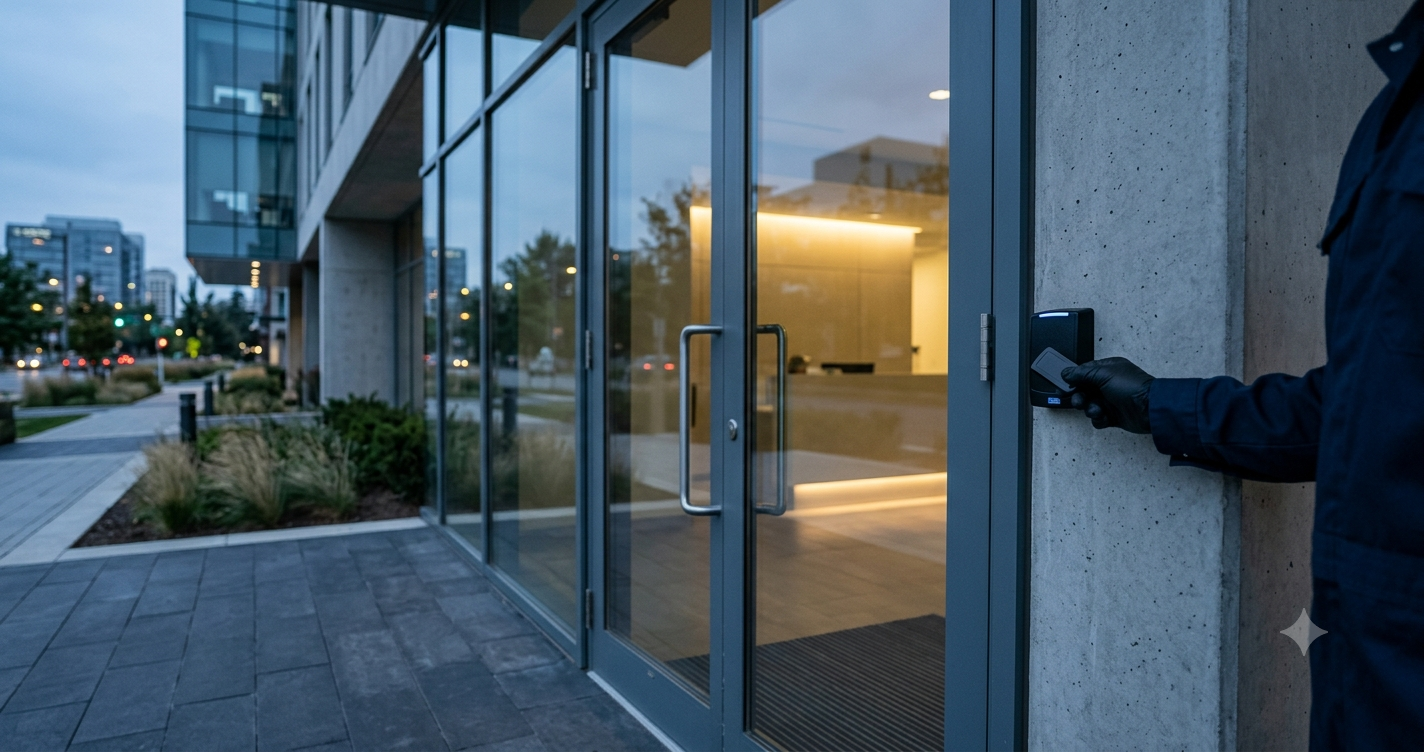
A lot of underpriced access control bids start with a definition problem. When a customer says "I want card access on six doors," they're picturing a reader on the wall. What you're actually installing on each opening is a reader, an electrified locking device, a door position switch, a request-to-exit sensor or button, and the homerun cabling back to a panel — plus the panel itself, a power supply, and the software licensing to make it all talk.
On the hardware side, a solid mid-grade proximity or mobile-credential reader runs $200 to $500. Electric strikes for a standard hollow metal frame come in around $150 to $400 for decent commercial-grade units. Maglocks look cheap on paper — you can buy one for under $200 — but by the time you've added the mounting brackets, the power supply sizing, and the fire alarm tie-in that code requires for magnetic locks on egress doors, that opening trends toward $600 to $1,200 all-in. Biometric readers push a door's total cost to $2,500 on the low end and up to $8,000 for high-security applications.
Then there's the panel. A two-door or four-door controller with its enclosure and supervised power supply typically adds $800 to $2,000 in hardware, spread across however many doors it serves. This is where door count changes your math: a single-door job carries the full panel cost on one opening, while an eight-door job spreads two four-door panels across the whole project. It's also why per-door pricing drops 15 to 25 percent on jobs with ten or more doors, and why your distributor will usually give you 10 to 20 percent off hardware when you're buying for a bigger project. Pass some of that through if you're in a competitive bid; keep the rest.
Building the labor number
Labor is where good access control shops make money and sloppy ones bleed it. The working consensus among integrators — and this matches what I've seen on real jobs — is 4 to 8 man-hours per fully controlled door, with 4 hours being a solid sales-estimating average for a typical interior hollow-frame door when the cable's already pulled. Add your cabling time separately: figure your normal per-drop labor for each homerun, because an access door usually needs a composite cable or multiple runs, not a single Cat6.
Panels get their own line too. Most estimators I know carry 3 to 4 hours per panel for mounting, terminating, power-up, and addressing. Then add commissioning and programming time for the head-end: enrolling credentials, building schedules and access levels, testing every door both directions, and training the customer. On a small job that's easy to forget, and it's a half day minimum even on four doors.
At billing rates of $75 to $150 an hour depending on your market, straightforward labor comes out to roughly $400 to $1,200 per door. In dense union markets like New York, the same door can run $600 to $2,500 once you're dealing with multi-story conduit, fire-rated penetrations, and prevailing wage. Retrofit work sits at the high end everywhere, because you're fishing walls that were never meant to be fished and replacing door hardware that's been painted over three times.
Now for the mistake that costs contractors more money on access control than any other, and I've watched it happen more than once: quoting off a floor plan without walking every single door. A door schedule tells you there are six openings. It doesn't tell you that two of them are narrow-stile aluminum storefront doors. A storefront door can't take a standard strike the way a hollow metal frame can — you're often into electrified panic hardware or specialty locks, and that one opening just went from a $300 strike and two hours of labor to $2,500 in hardware and a coordination dance with a locksmith. One integrator I know ate almost $6,000 on a dental office job because the "six interior doors" on the plans turned out to include two glass storefront entries and a fire-rated stairwell door that needed fail-secure hardware and a fire alarm relay. Survey every opening. Open the door, look at the frame, look at the lock, look above the ceiling. Twenty minutes per door on the front end is the cheapest insurance you'll ever buy.
The recurring revenue most shops leave on the table
If you're still selling access control as a one-time install, you're building a job list instead of a business. Cloud-hosted and managed access control has changed the economics, and the customers coming to you now — especially anyone under 45 who's used to managing everything from a phone — expect a subscription model anyway.
Here's how the money works. Cloud platform licensing typically costs you, the dealer, somewhere between $3.50 and $15 per door per month depending on the platform and your volume. Dealers are turning around and charging customers $20 to $60 per door per month for the hosted service, and bundling in credential management, firmware updates, database changes, and a service response commitment. On a modest twelve-door customer, that's $300 to $700 a month in recurring revenue against maybe $100 in platform cost — and it renews every year without you bidding against three other shops.
The kicker is what it does to your company's value. Security businesses get valued largely on recurring monthly revenue, with multiples commonly running 26 to 46 times RMR. Every $1,000 a month in access control subscriptions you build is potentially $26,000 to $46,000 added to what your company sells for someday. No install margin compounds like that.
So when you present pricing, structure it in two parts: the installation price and the monthly service price. Some shops go further and drop the upfront number — subsidizing hardware to win the deal — because the lifetime subscription value covers it. I'd be careful with that until you've got enough RMR cushion to float the hardware cost, but it's a real strategy and national players are using it against you right now.
Put it all together and here's what a defensible quote looks like for a typical four-door commercial retrofit in a mid-size market: roughly $4,000 to $6,000 in hardware including the panel and power, $3,000 to $5,000 in labor covering cabling, door hardware, termination, and commissioning, and something in the range of $120 to $240 a month for the cloud service and support. That's $8,000 to $11,000 up front — squarely inside the $2,000 to $4,500 per-door range the market supports — plus recurring revenue that keeps paying you for years.
One last thing: carry a 10 to 15 percent contingency on anything involving an older building, and say so in your proposal as an allowance for concealed conditions. Access control touches doors, and doors are where a building's whole remodeling history comes back to haunt you. Price like you know that, because after your first storefront-door surprise, you will.
Keep reading

Quote faster with NexVolt
Professional, branded estimates for low-voltage work, in minutes.
Start your free trial